
Reading-level signing
Each measurement carries a hardware-rooted signature.
The signing key never leaves the device. Tampering with the device invalidates subsequent readings; missing readings leave a gap that's visible in the chain.
Product · Field & Infrastructure · Production
Regulatory enforcement instrument for electricity distribution. Detect, prove, and report unauthorized consumption — with hardware built for hostile field conditions and an audit trail that survives a regulatory dispute.
The problem
Distribution operators have been measuring unaccounted-for energy losses for decades. The technical detection is well understood — the gap between what enters the network and what's billed at the meter is the loss. The dispute begins when the operator tries to act on the loss: which consumer, what evidence, what holds up at a hearing.
FieldEye is built for the second half of that problem. It is the instrument the operator deploys at the suspected site — robust enough to survive the field conditions, accurate enough to be defensible, and producing an audit trail (signed, sequenced, tamper-evident) that the regulator and the operator's own legal team can rely on six months later.
What it produces
Reading-level signing
The signing key never leaves the device. Tampering with the device invalidates subsequent readings; missing readings leave a gap that's visible in the chain.
Sequenced chain
Each reading references the cryptographic hash of the previous reading. A spliced or reordered chain fails verification at the regulator's end.
Sovereign telemetry
We do not custodian the evidence. The operator does. We provide the verification tooling so a regulator or a defending party can recompute the signatures independently.
Hardware
FieldEye is a sealed, ruggedized instrument intended for the conditions distribution operators actually work in: outdoor mounting, dust, vibration, temperature extremes. Power supply tolerates the messy waveforms found near the suspected interference. Communication is configurable — cellular, LoRaWAN, or local store-and-forward to a paired collector.
Pricing is per-deployed-unit, with the audit-log software provided to the operator for life of the unit. We engage in either a hardware-supply mode (you operate the deployments) or a managed-deployment mode (our team installs, monitors, and supports under SLA).
Where it fits
The operator has technical detection of network losses and needs evidence that survives a contested hearing. FieldEye produces the per-customer measurement record that names the loss to a service drop, signed and chain-linked, defensible six months after the event.
Specific suspected sites — residential or commercial — where the operator wants instrument-grade evidence before pursuing recovery. A short deployment of FieldEye units across the suspect feeder produces the measurement record without alerting the suspected party to a meter visit.
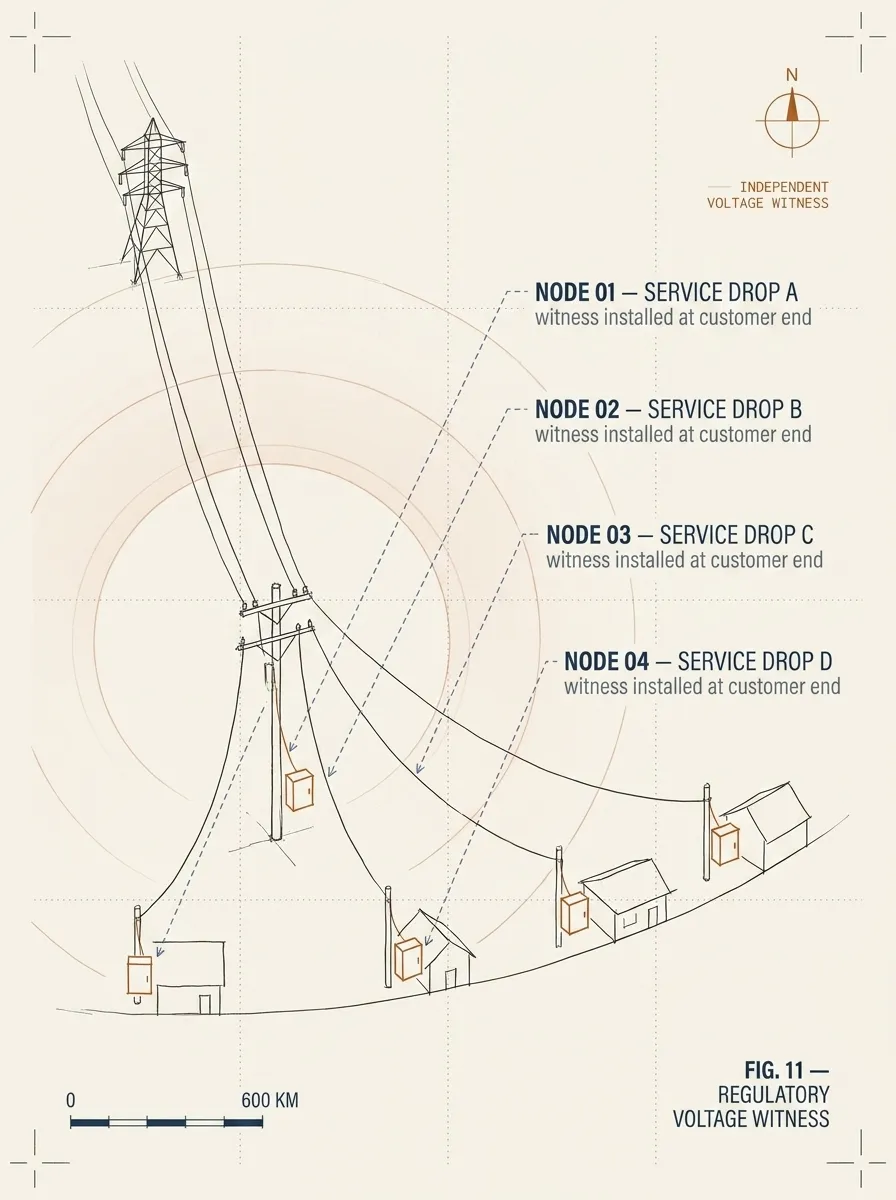
When a regulator and a regulated operator disagree about service-band delivery, the regulator needs an independent witness — not the operator\'s own readings. FieldEye is deployed by the regulator (or by a court-appointed expert) and the resulting evidence chain is verifiable without involving us.
Ongoing oversight of a regulated operator under a consent decree or compliance program. FieldEye runs continuously at the agreed sample of customer drops, producing an evidence stream the regulator can reference at any future review without re-instrumenting the network.
Patterns that use this product
Government · Pattern
How we designed offline-first integration for a Northern anchor institution: local-first state, queue-and-replay sync, idempotent integrations. The field worker never knows the link dropped, and the back-office systems reconcile cleanly when it returns.
10–14 weeks for the first deployment
Energy · Pattern
How we shipped independent voltage-presence witnessing at the customer end of a distribution network — so when the regulator audits a service-band claim six months after the fact, the evidence stands without depending on the distribution operator's own systems.
12–18 weeks per deployment phase
For distribution operators
Tell us about the deployment scale and the regulatory framework. We'll come back with a hardware spec and a managed-vs-self-operate proposal within the week.
Talk to an engineer