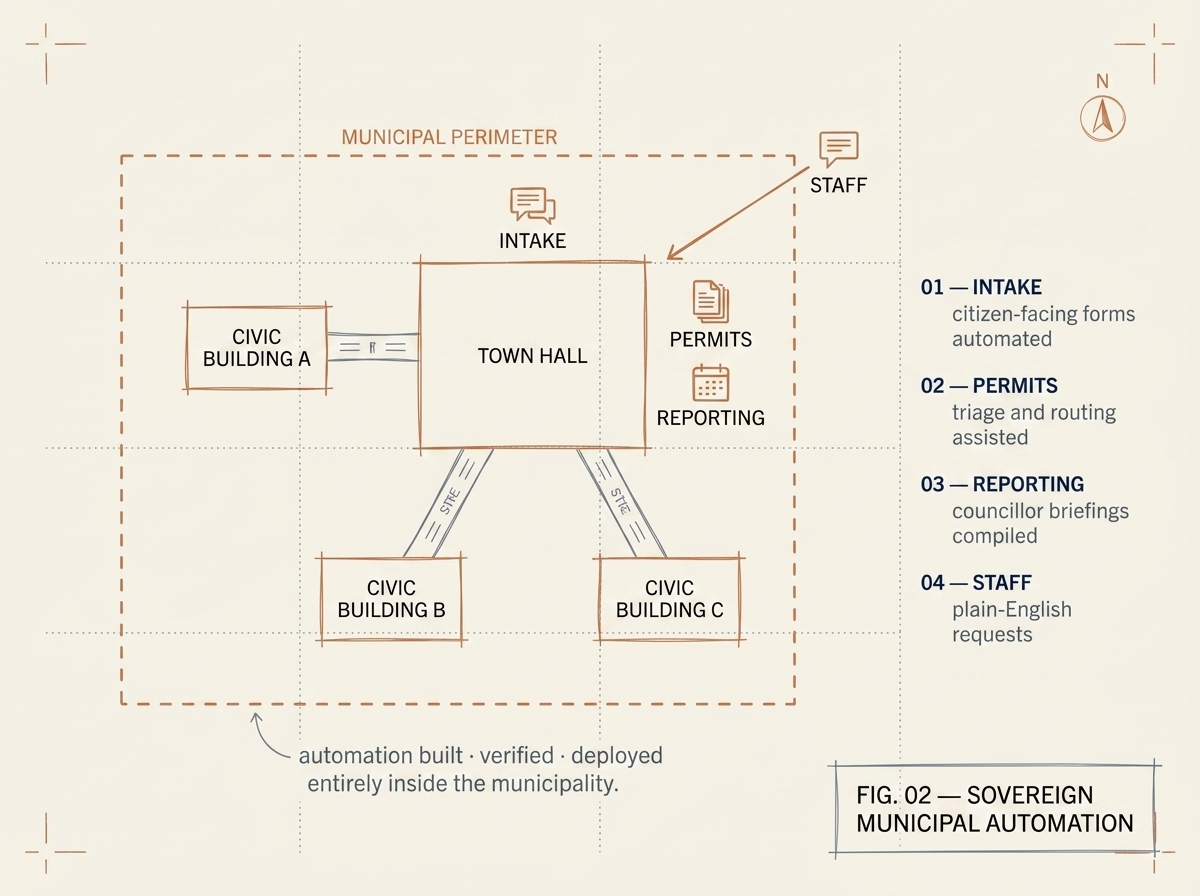
The constraint that defines this sector is not technical complexity — most municipal IT estates are smaller than a mid-market enterprise. It's sovereignty plus accountability: every system that touches a citizen record has to be defensible to council, to the provincial privacy commissioner, and to a procurement officer who has to justify the contract publicly. Foreign cloud services, opaque AI vendors, and offshore delivery teams fail that test.
We design for that constraint by default. Our products run inside the customer's sovereign cloud tenant or on-premises, and our integration work touches the systems the municipality already runs — enterprise platforms, ERPs, geospatial systems, asset and permit registries, BI tooling. When AI is in scope we deploy the model where the data lives, not the other way around.
The other defining constraint is scale inversion: a municipality of 80,000 has the regulatory complexity of a large enterprise but the operations headcount of a mid-sized SMB. Generic enterprise products are over-engineered and mis-priced. We engage in two modes — full-stack delivery for smaller municipalities, integration-only for larger ones with their own ops teams.